
Knoxville Voter Registration Lookup
Use the official Tennessee Voter Registration Lookup and Absentee Ballot Status Tracker for a personal status check. Choose Knox County when the registration belongs in Knoxville. The form is identity-gated, which means it does not let a visitor browse a list of local voters by name alone. Enter the name as it was registered and supply both requested parts of the birth date.
The form inspected for Knoxville uses five identifying fields before Submit. Each one is required. This tight match design helps explain why a nickname, changed surname, old county, or mistyped birth value may fail even when a registration exists.
| Lookup entry | Control | Needed? | How to enter it |
|---|---|---|---|
| County | Dropdown | Yes | Select Knox for a Knoxville registration. |
| First Name | Text | Yes | Use the registered given name. |
| Last Name | Text | Yes | Use the registered surname. |
| Birth Month | Dropdown | Yes | Choose the month only. |
| Birth Year | Dropdown | Yes | Choose the year only. |
The state lookup shown below is the personal verification route. Because no sanctioned matched record was captured during research, no claim is made here that a successful result contains a fixed set of fields.
The official Tennessee lookup source shows the exact Knoxville status-check entry screen.
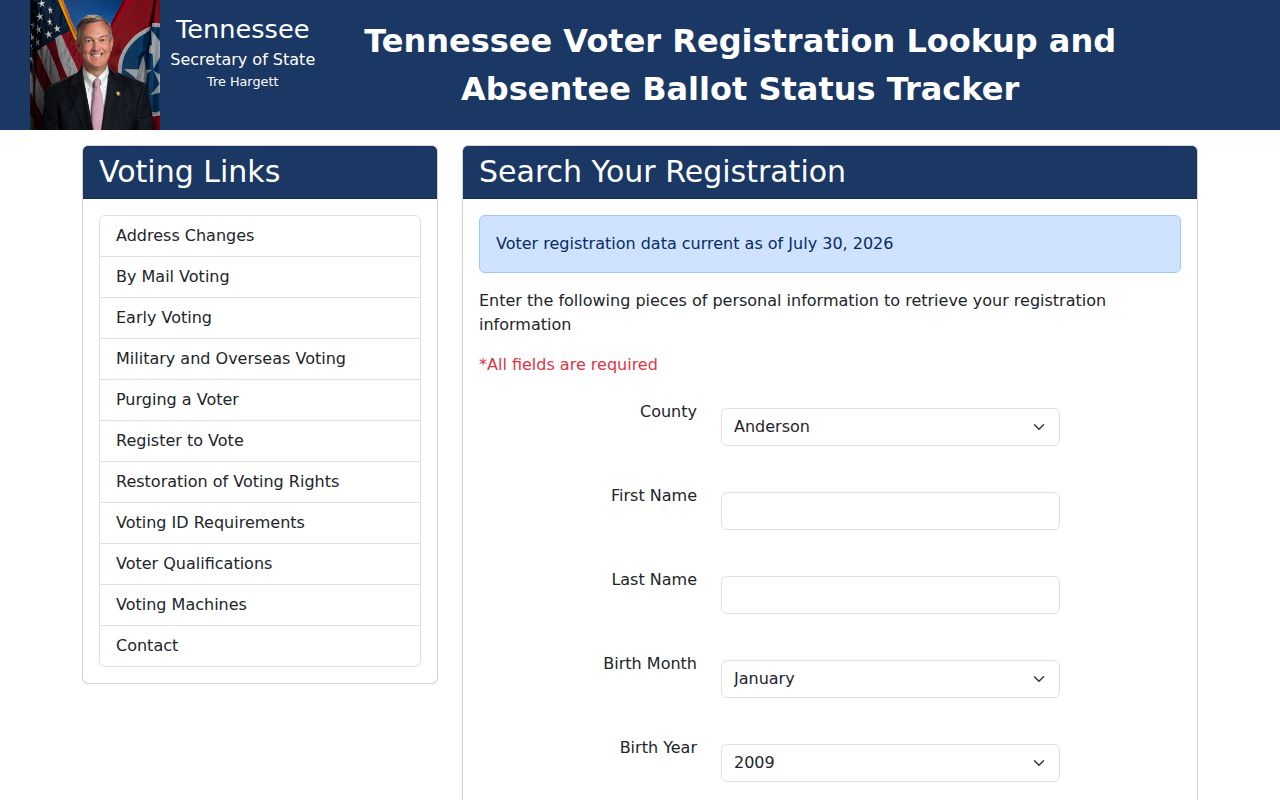
Its county, name, birth-month, and birth-year controls make clear why the tool is not a public name directory.
Knoxville Voter Record No-Matches
A failed query is not proof that a person has never registered. The portal's verified no-match message says that no record was found, asks the user to check the information, and points the voter to the county election commission. First retry the registered spelling, birth month, birth year, and county. A recent move may also mean the voter needs to update an address rather than keep testing new versions of the name.
The fallback is the Knox County Election Commission at 400 Main Street, Knoxville, telephone 865-215-2480. It handles local registration and election questions. Its public resources include Where Do I Vote, polling maps and lists, sample ballots, candidate material, notices, and early-voting statistics.
The county elections source provides the local office route when the state screen does not resolve a Knoxville voter record.

This local channel is also the right place to ask about a mailed voter card or the processing of an update.
Note: Online submission alone does not complete registration; county processing completes it, and the office mails the voter card.
Tennessee Voter Record Contents
Tennessee's administrative record may contain far more than the five values entered into the public lookup. The inventory below describes fields the election system can hold. It is not a list of fields promised on a matched public result. Access depends on the field, the request channel, and the confidentiality statutes.
| Identity | Last, first and middle names, suffix, former name, sex, and optional race on the paper form. |
|---|---|
| Contact and place | Residence, a different mailing address, county, phone, email, and former county or registration address. |
| Registration | Registration date and status, precinct, and election districts. |
| Election activity | Elections in which the voter participated and absentee request or status data, never ballot selections. |
| Qualification data | Birth facts, signature, citizenship material, identification numbers, and felony or rights-restoration information where applicable. |
Name, address, county, status, precinct, and participation facts may be part of the public side of voter records, subject to protections. Internal identity and qualification fields do not all become open merely because the registration record is inspectable.
Knoxville Voter Records and Redactions
Tennessee citizens may inspect voter rolls under Tenn. Code Ann. §§ 2-2-127 and 2-2-138, but the law draws firm lines around sensitive data. Social Security numbers, driver-license numbers, and Department of Safety or Homeland Security identification numbers are excluded or redacted. Tenn. Code Ann. § 2-2-141(e) also closes citizenship-proof documents and the databases used to check them.
Confidential by Tennessee law. Protected identifiers and citizenship evidence are not public voter-file fields. Tenn. Code Ann. § 2-6-502(b) also protects specified Social Security, birth-date, mailing, and email data on covered absentee or temporary applications.
Safe at Home information and other protected-voter data receive more safeguards. These exclusions apply whether someone seeks one Knoxville voter record or a larger file. For the broader law governing government records outside elections, use the Knoxville public records access overview.
Knoxville Voter History Myth
Tennessee does not register voters by political party. A person's choice to participate in a particular primary is not the same thing as permanent party affiliation. Treating it as such can produce a false claim about that voter. A participation history may show that the person took part in an election, but it cannot expose a vote for any candidate or measure.
That line is crucial when reading Knoxville voter records. Election history records an act of participation. The secret ballot protects the selection itself. No election file, public inspection, or personal status screen turns voting history into a view of marked choices.
Myth: Voter history reveals a ballot. Fact: It can indicate participation only. Tennessee has no party registration, and ballot selections stay secret.
The Tennessee Division of Elections is the statewide source for forms, rules, and voter resources.
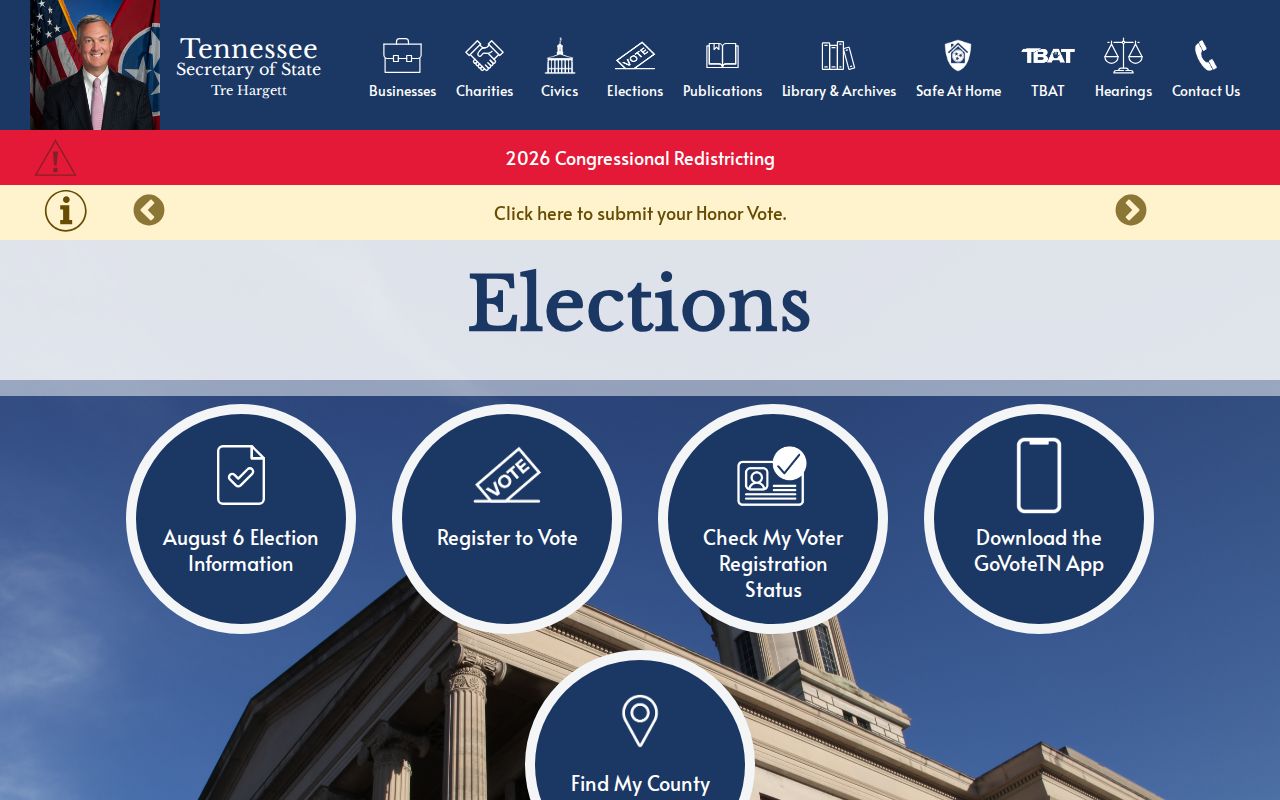
The statewide elections hub complements the personal lookup and the Knox County office without changing the privacy boundary around ballots.
Knoxville Safe at Home Records
The Secretary of State's Safe at Home program supplies a substitute address and mail forwarding for qualifying victims. An application must be completed through a certified application assistant. A participant and the participant's children may use the substitute address for many state, local, school, and benefit purposes. Election records tied to a protected voter receive added safeguards.
Safe at Home does not change a person's identity or wipe old records. It also does not relocate the participant. Statutory exceptions cover property listing, assessment and tax collection, and recorded real-property instruments, so a substitute address cannot simply replace the actual location in every public system.
The official Safe at Home source explains the Tennessee protection that can affect Knoxville voter records.

The program protects future address use in covered settings, but it should not be read as retroactive erasure of all public files.
Note: Never try to work around a protected address or use election data to locate or contact a person against their wishes.
Knoxville Voter Registration Maintenance
Knox County updates election records through voter-submitted changes, returned mail and address confirmation, and official matching processes. Death records, duplicate registrations, felony status and rights restoration, and citizenship checks can also affect a file. These events do not all mean the same thing, and a status should be confirmed with the Election Commission before drawing a conclusion.
Federal National Voter Registration Act safeguards require notice and waiting steps in relevant confirmation cases. Inactivity by itself cannot trigger immediate cancellation. The Tennessee tool links to a voter-purge explanation, but the research did not verify a current numeric state timeline suitable for publication. That gap matters: a precise cancellation period should come from the current election authority, not an old summary.
For a change of name or address, Tennessee also offers an online filing form. The system can obtain an electronic signature from the Department of Safety, yet the county still must process the filing.
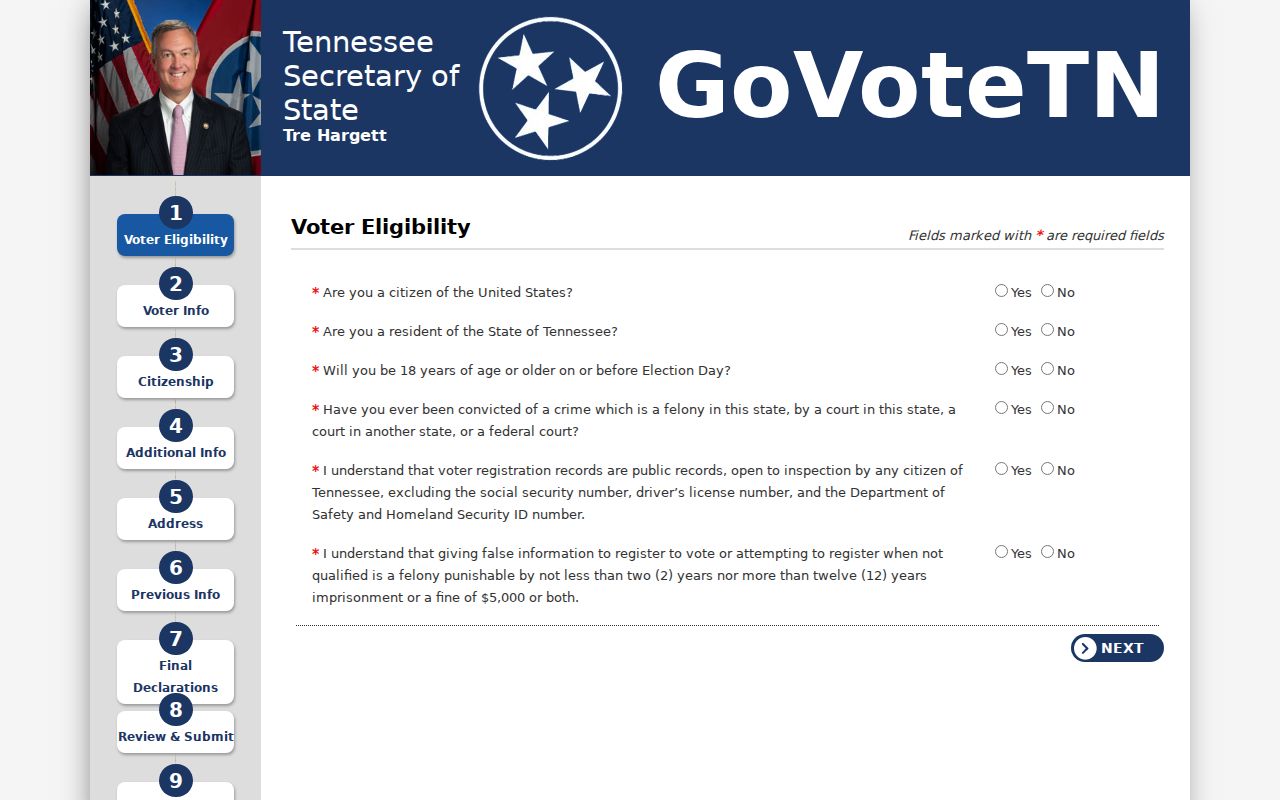
This registration channel is meant for submitting information, while the separate lookup is used to check status and election details.
Get Tennessee's Knoxville Voter File
The full voter file is not an expanded version of the five-field lookup. Under Tenn. Code Ann. § 2-2-138, county lists and compiled voting history may be purchased for no more than production cost only after the requester certifies on a State Election Commission form that the data will be used for political purposes. The same type of certification applies to statewide compilations.
Knox is a computerized county, so delivery must be electronic. The statute still includes legacy language about a diskette, which makes the current medium an item to confirm with the commission. Research found no accessible current request PDF, fixed dollar quote, or verified medium menu. The law sets a cost ceiling, not a statewide flat charge.
- Contact the Knox County Election Commission and identify the list or geographic area sought.
- Complete the State Election Commission certification of political purpose with requester identity, signature, and date.
- Ask the office to state the production cost and current electronic delivery method before payment.
- Keep the certification and use the file only for the stated lawful political purpose.
In a covered large county such as Knox, the commission must act on a citizen's request within seven days. A rejection or modification must be explained in writing. This is a distinct election-law route, not a way to bypass protected voter registration fields.
Historical Knoxville Voter Rolls
When an older voter does not appear in the current system, begin with the Knox County Archives, then ask the Tennessee State Library and Archives or McClung Historical Collection about poll books, registration lists, and microfilm. The research confirms those institutions as historical fallbacks, but it did not verify exact Knox County poll-book titles or year spans. A catalog or reference inquiry is needed before a visit.
This is one place where the online/offline divide matters. Knox County Archives preserves non-current permanent county records dating from the county's creation in 1792. That broad record trail does not prove that every voter series survived from that date. Give the reference staff a person's name, approximate election year, and Knoxville area, then ask which election record series actually covers that period.
Note: Historical coverage must be confirmed by record series; the county's early founding date is not a promised start year for poll books.
Use Knoxville Voter Records Lawfully
Public access is not permission to intimidate, stalk, harass, threaten, or expose a protected person. Tennessee stalking and harassment laws include Tenn. Code Ann. §§ 39-17-315 and 39-17-308. Keep a voter file within the political purpose certified to the election authority, and do not turn a participation record into a claim about party membership or ballot choice.
Accuracy also calls for restraint. A no-match can reflect the values entered, a county change, a recent update, or processing status. A current record may change after the next update. Confirm a disputed fact with the Knox County Election Commission, preserve the date of the source, and state only what the official record supports.
Can a public voter record justify unwanted contact? No. Public inspection and political-purpose file access do not cancel anti-harassment law or protected-address rules. Use the least data needed, honor boundaries, and report an immediate threat to the proper authority.